'Certain advertisements, posters, packages, logos, books and magazines endure as sign posts of artistic, commercial, and technological achievement
that often speak more about particular epochs or milieus than fine art ’(Heller
and Pomeroy 1997).
This was the key inspiration behind my publication. I thoroughly believe when it comes to the representation of culture and society that Graphic Design is the medium through which it can be viewed the most clearly. So to put this theory into practice I decided to produce a picture book depicting graphic design examples of a certain era- I chose the 90's as it's a decade close to my heart and one I remember with fondness- and also one that I feel is easily definable through design.
The title of the publication is: Defining a Decade through Design.
The title of the publication is: Defining a Decade through Design.


The format I chose for my book was 89x148, the exact dimensions of the original game boy- which would also be the front cover. The images included and gathered would all be examples of 90's design. (originally I had wanted to include more clothing and toys into the book, however I felt these were examples of design and not specifically Graphic design and so most of my content was made up with packaging, posters, magazine and album covers.)
It was at this point that I decided to change the binding of the publication from a stitch bind to a concertina bind. I felt that this style of publication lent itself better to picture books and more 'arty' looking pages. Also it meant that each page could be appreciated individually as well as the publication as a whole when you fully stretched it out.
For my inspiration into the look, layout and design of the pages I looked into 90's graphic design- mostly David Carson and, I really like his stuff.


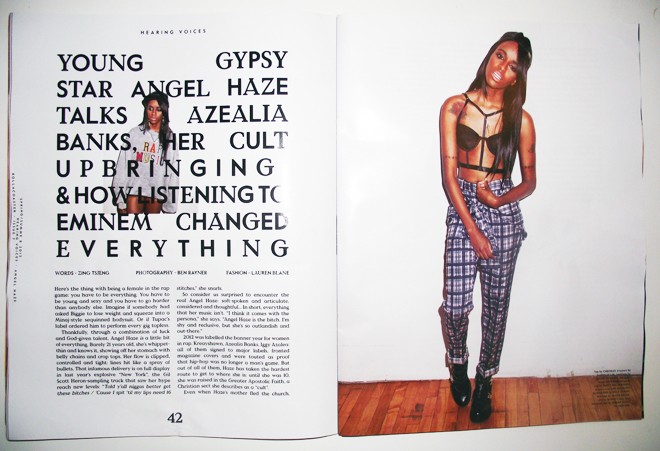


I found a lot of 90's design has a visual beauty to it that doesn't consider form or function, it considers personalty above everything and that spoke to me so much more than clean, dull and empty modernist design. What's the point of being a creative if you're not even going to try and make something look beautiful?
I enjoyed creating a 'mess' in the background on which to place my images. It was a refreshing way of thinking about design, I didn't have to consider the practically rather the look and this appealed to me.
I enjoyed creating a 'mess' in the background on which to place my images. It was a refreshing way of thinking about design, I didn't have to consider the practically rather the look and this appealed to me.
For my fonts I only used fonts developed in the 90's -FF Tokyo and FF Gothic were my two choices. Both looked drastically different from each other whilst still remaining bold and unapologetic- characteristics I wanted to represent of the decade.
 |
| FF Gothic |
| FF Tokyo |
Final Publication
 |
| The front cover and format were inspired by a Game Boy, how cool is that? |


 |
| The actual title of my publication hidden at the back: Defining a Decade through Design: The 90's |


Evaluation
As a whole I really do like my publication- it may not be the most intense book ever produced but I do feel as a piece of design it is successful- it sums up the decade of the 90's through pictures and layout design. I really like the look of it, the slight chaotic beauty really appeals to the scatter brain in me.
The production of this book could've been done better. The stock I printed on didn't lend itself too easily to being folded concertina style and the attempts to stick the font and back pages together resulted in some bubbling on a few of the pages- this really bugs me because other than that it worked out very well. I think this was due to the way I printed my pages as a continuous piece of paper rather than dividing them into sections to glue together.
I believe this publication highlights one key theme I refer to in my essay- That Graphic Design is a better communicator and representation of particular times, epochs and decades than fine art. This is the driving inspiration and rational behind the entire book. The representation of the 90's through graphic design demonstrates that graphics can represent particular times and sum up the tone and feel of a certain decade.

No comments:
Post a Comment